
Managing substitutions in junior hockey: one app for subs, score and stats
How to run substitutions in a junior hockey team without a notebook, and why parents prefer one app for subs, the score and season stats across 12 sports.

The simplest way to manage substitutions in a junior hockey team is to stop counting in your head. Put a clock on every player, let it count time on and time rested, and let it suggest the next swap so you only have to confirm. LineUp does exactly that on the manager’s phone, and because the score and the minutes are recorded as you go, the result and the stats reach every parent at full time without a single message being written. This article explains why subs go wrong, what a substitution tracker needs to do, and how LineUp handles it for hockey and eleven other sports in one app.
Why are substitutions the hardest part of managing junior hockey?
Every other job a team manager does has a natural time slot. Replies come in during the week. The draw gets added once. Oranges and the packet of lollies are sorted by the previous player of the day. Substitutions happen during the game, at the moment your attention is most divided, with a coach beside you, a parent asking a question and a ball in play.
The tools most managers reach for do not help. A notebook needs a pen, a dry page and a free hand, and turf-side in July none of those are easy. A memory needs a game without incident. The standard result is familiar to anyone who has stood by the halfway line: a quiet child who spent most of a half on the bench because no one noticed, a confident one who never came off, and a manager who felt bad about both on the drive home.
Junior hockey makes this harder than most sports. Eleven players on the field, three or four on the bench, two halves and rolling subs that can happen while play goes on mean a dozen or more changes a half. Add a goalkeeper the coach usually wants left in, and each change is a small decision about who has had a run and who has not, made with incomplete information.
What does a substitution tracker need to do?
Strip it back and a sub tracker has four jobs.
Count time on and time rested for every player, live. Not minutes you enter afterwards. A number you can glance at while the ball is in play and know that Olivia has been on for 22 minutes and Nikau has been sitting for eight.
Suggest the next swap. The manager should not have to work out who is next. The tracker proposes a player off and a player on, and the manager accepts or changes it.
Confirm a sub in one tap. If making a change takes longer than the change itself, the tracker will be abandoned by the second game.
Record the result for everyone. Minutes, score and scorers should be saved as part of the game, not copied into a chat afterwards.
Sometimes a player comes off hurt, and it is a nightmare swapping the subs around. LineUp allows you to do this in a few taps.
Anything beyond that is nice to have. Anything less than that and you are back to the notebook.
How does LineUp manage hockey substitutions?
LineUp’s live screen for hockey shows the score for both sides with the clock under it, the substitution panel, the field with your players in position, and the bench with how long each player has rested. Everything below happens on that one screen, and the substitution panel works at any time during play, which is how hockey’s rolling subs work. Your grade’s rules and the umpire still have the final say on when.
Time on and time rested. Every player on the field has a bar counting how long they have played this game. Every player on the bench shows how long they have rested and how long they have been on. Both update every second. You scan the list and you know.
The rotation. When you open the substitution panel, it is already filled in: Off, the next player in the rotation, and On, the player who has rested longest. The rotation puts every starting player in a random order, each comes off once before the cycle starts again, and the order reshuffles for the next cycle so the same child is not first off every week. Under the pair, Next subs shows the following two or three swaps, so you can tell the next player to get ready on the line.
One tap to confirm, one tap to change. Tap Make sub and the swap is done. The player coming on takes the position of the player going off, the field diagram updates, the bench updates, and the player who came off starts resting. If the coach wants a different name, tap it and pick someone else before you confirm. LineUp suggests. The coach decides.
The goalkeeper. LineUp has no special goalkeeper rule. The keeper is the player in the Goalkeeper position and is part of the rotation like any other starter. When the rotation suggests the keeper comes off and the coach wants them to stay in, tap the Off name and choose someone else.
Half time in three taps. Say you have eleven on the field and four on the bench. Tap End H1. The break screen shows the score, the bench with rest times, and the first suggested swap. Make sub. The panel reloads with the next pair. Make sub. Then the third. Three taps, three changes, and the field shows the new eleven in position. If you are changing keepers at the break, make that sub here and the new keeper takes the Goalkeeper position. Start H2 when the umpire is ready.
Late arrivals. A player who said they were coming but is not there at the first whistle sits in an absent list. When they get to the turf, tap Mark arrived, pick their name, and they join the bench with their rest clock running.
The clock keeps running. Lock your phone, take a call, put it in your pocket. The game keeps counting and resumes where it was if the app is closed.
What do parents see, and what do they stop asking?
This is the part of substitution management that is easy to forget. The manager’s problem on Saturday is the sideline. The parents’ problem is Saturday night, when they want to know how it went, who scored and how long their child was on.
In LineUp, the live screen is the manager’s. Parents see the fixture, the venue and their own reply during the game. At full time, LineUp asks the manager to end the game and, if the team picks a player of the day, to choose one. Then it saves the summary: the result, the scorers, player of the day, and minutes played for every player who was there.
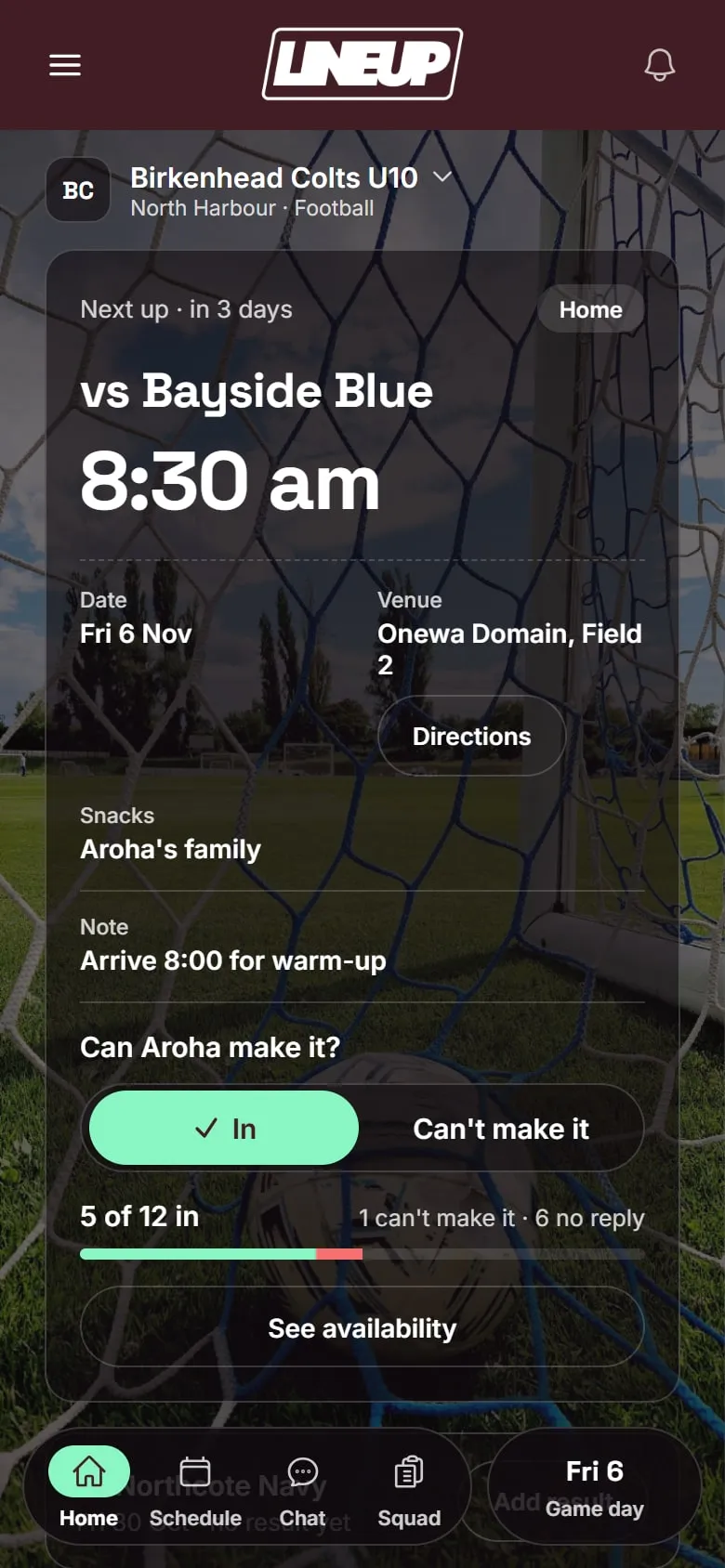
That same summary is the page a parent opens in their own app a few minutes later. Nobody typed it. Nobody posted it to a chat. The manager’s job ended when the umpire blew for full time.
What parents stop asking, in roughly this order: which turf, what time, did we win, who scored, how long did she play. All five are answered on the game’s page.
Does the score and the stats need any extra admin?
No, and this is the point of running subs and score in the same place. In most teams the manager tracks subs one way, scores another and the stats a third, if at all. Each one is a separate piece of admin and the last one usually does not survive the season.
In LineUp, tap your side’s score when the ball goes in. The app asks who scored, with the players on the field listed first. Pick one, or skip it if you did not see. Tap the other side’s score when they score. Undo takes the last goal back off the board and off the player it was credited to, for the one the umpire disallows.
Because the goal, the scorer and the minutes are recorded during the game, the stats build themselves. On the team screen the season so far adds up: the record, the goals, the players of the day. Minutes played across the season are there for the manager as a quiet hint, with no target and no colour-coding. There is no spreadsheet to update on Sunday and nothing to send.
LineUp keeps the team’s own score. If your association asks the team manager to submit the result in PlayHQ or RevSport, do that as well.
Why does one app for 12 sports matter to a family?
Most junior sports families are not one-sport families. The child who plays hockey in winter plays cricket or touch in summer. A sibling plays netball. A parent manages one team and is a sideline parent for another.
Each sport in New Zealand and Australia tends to come with its own system: the federation’s registration platform, a scoring app for the competition, and whatever the manager chose for the group. A family with two children in three sports can be in six apps and four chats by April.
LineUp runs football, netball, basketball, rugby union, rugby league, touch, hockey, cricket, AFL, water polo, softball and tennis in one app. Each team is set up for its own sport, with its own clock, its own scoring and its own game-day screen. The cricket team has a ball-by-ball scorebook. The softball team has an innings scoreboard. The netball team has quarters and bibs. The hockey team has the rolling subs described above. The parent switches between them in the same app, with the same invite-code join and the same In or Can’t make it reply.
For the manager who runs two teams in two codes, that means one way of working all year rather than relearning a new app every season.
How do you set it up before Saturday?
Setup takes about ten minutes and is worth doing in one sitting.
- Create the team and choose Hockey. Check players on the field, periods and minutes per period against your grade. Set the team colour and add the club logo if you have it.
- Add the roster. Every child’s name, once. Parents attach themselves to these entries when they join, so you do not need any parent details to start.
- Add the games from the draw with the turf as the venue and the start time. Add training once and set it to repeat weekly.
- Turn on what your team does. Player of the day, snack duty, or neither.
- Share the invite code. Paste it wherever the parents already read. Each parent joins, finds their child on the roster, and is done. Children do not have accounts.
How your team gets on LineUp is three steps. From there the fixture reminds people the evening before, and on Thursday you can see who is in.
A few things managers ask
Does the rotation judge anyone? No. It shows minutes and offers a turn. It never scores a child’s game time, never tells the coach who deserves to play, and never shows parents a verdict.
Can two of us run it? Yes. A second parent can manage the team, and whoever is at the turf runs the game from their own phone. The season record is the same for both.
What about an injury? Sub them off like any other change, in the middle of a half if you need to, and their minutes stop. They go to the bench, so if they cannot go back on, tap the On name when the rotation offers them and pick someone else.
Can I ignore the suggestions and sub however I like? Yes. Tap either name, pick anyone, confirm. The clock and the record work the same whether you follow the rotation or not.
We play 7-a-side in quarters. Does that work? Yes. Change players on the field and the number of periods in team settings. With four periods the labels become Q1 to Q4, and the break screen comes up at each quarter.
If you want the full Saturday walkthrough, Rolling subs and time on for junior hockey in LineUp covers the starting eleven, the halves and the summary step by step. If you are still choosing an app, Best app for managing a junior hockey team in NZ and Australia sets LineUp alongside PlayHQ, RevSport, CoachMate, Stack Team App and Spond. Everything we have written about hockey is here. And if you run a club with several hockey teams, get in touch.
Questions people ask
- What is the easiest way to manage substitutions in junior hockey?
- Use a clock that counts time on and time rested for every player, and let it suggest the next swap. LineUp does this on the manager's phone. You tap to confirm each rolling sub, and the minutes are recorded for you.
- Do parents need to download anything to see the result?
- Parents join the team once with an invite code. After that the result, the scorers, player of the day and their child's minutes appear on the game's page in their own app, with no message from the manager needed.
- How do I keep my goalkeeper on for the whole game?
- LineUp has no special goalkeeper rule; the keeper is the player in the Goalkeeper position and is part of the rotation. When the rotation suggests the keeper comes off, tap the Off name and choose someone else.
- Does LineUp tell the coach who to sub off?
- It suggests. The rotation offers the next player off and the longest-rested player on, and you can change either name before you confirm. The decision stays with the coach.
- Can I use LineUp if my child plays hockey and another sport?
- Yes. LineUp runs 12 sports, including football, netball, basketball, rugby union, rugby league, touch, hockey, cricket, AFL, water polo, softball and tennis. Each team sits in the same app and you switch between them.
- Is LineUp free?
- LineUp is free to download today on iPhone and Android. There are no ads and children do not have accounts.