
Scoring and subs for junior rugby union in LineUp
A junior Rugby Union Saturday in LineUp: positions on the field, the clock for each half, subs from the bench, and tries and kicks credited to the right player.

In LineUp, a junior Rugby Union game is your team on a field diagram in real rugby positions, a clock for each half, a substitution panel that already knows who has rested longest, and a scoreboard that knows the difference between a try and a conversion. You set the team before kick-off, make subs with every child’s time on and time rested in front of you, and credit each try and each kick to the player who scored it. At full time the result, the scorers, player of the day and everyone’s minutes are saved to the season. Here is the Saturday, in order.
What does rugby game day look like in LineUp?
Four screens. The game, where you can see who is coming. The team-setup screen, where you pick starters and give them positions. The live screen, with the score, the clock, the sub panel, the field and the bench. And the game’s summary after full time.
A Rugby Union team in LineUp defaults to ten players on the field and two halves of 20 minutes, labelled H1 and H2. The positions on the field diagram are Loosehead Prop, Hooker, Tighthead Prop, Flanker, Number 8, Halfback, First Five, Centre, Wing and Fullback. Grades differ by age and by union, so check yours. If your grade plays more a side, set the number in team settings and the extra players get generic spots on the diagram. Shorter or longer halves are the same kind of change.
Before the game
The draw is already in. You add the season’s games once, with the venue and the time, and weekly training repeats to the end of the season. Each game has a map, and families can add it to their calendar. When the draw sends you to an away ground across town, the details are on the game, not somewhere up the group chat.
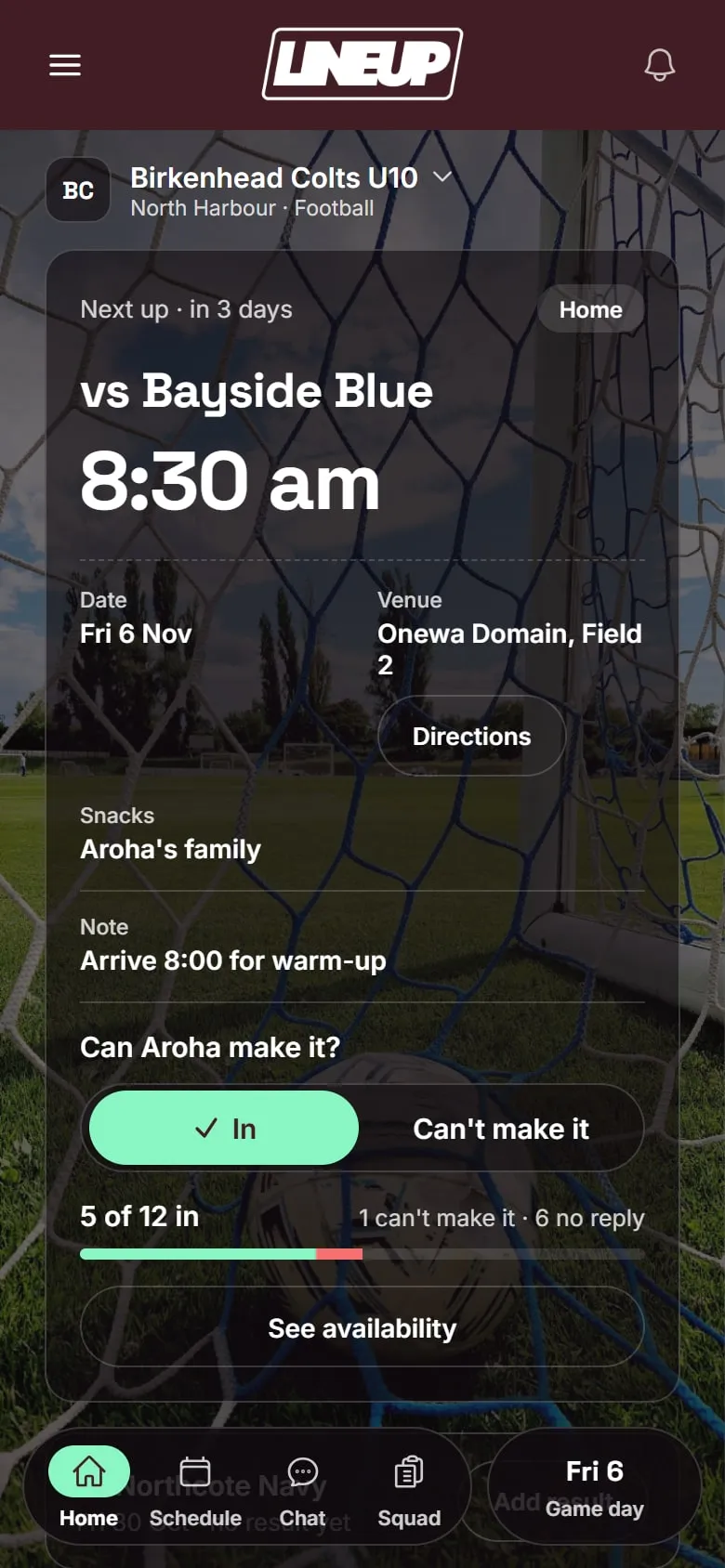
By Friday, you know who is coming. Parents tap In or Can’t make it on the game. On the evening before, LineUp reminds anyone who has not replied. You see who is in, who can’t make it, and who has not replied. Rugby with a short bench is a long morning, so knowing early matters.
How families got here. One invite code from you, sent however you like. Parents join with it, and one parent account can follow several children and teams. Children do not have accounts; you add the players’ names. How a team gets started is three steps.
Setting the team up for rugby
If the season has not started yet, ten minutes of setup makes every Saturday shorter.
- Create the team and choose Rugby Union. Check players on the field, halves and minutes per half against your grade’s rules.
- Choose the scoring rule. Standard is try 5, conversion 2, penalty 3 and drop goal 3, with a button for each. Junior is tries only, one point each, with a single Try button. Pick the one that matches how your grade keeps score.
- Set your colour and logo. The app re-themes to the team colour.
- Add the roster. Every player’s name, once.
- Add the games and training. Training goes in once and repeats weekly.
- Turn on what your team does. Player of the day, snack duty, both or neither.
- Share the invite code, and if another parent is helping, they can manage the team with you.
Picking the team and the positions
Start game day from the game. LineUp lists the players who said they were in. Choose your starters and your bench, then give each starter a position, and the field diagram shows each of them in place. A player who said In but is not there at the start can be marked arrived later, when they turn up.
During the game
The clock. Start it with the referee’s whistle. It shows the minutes of the current half and keeps counting past the period length, so if the referee plays on you can see by how much. Tap to pause it when play stops for an injury.
Time on and time rested. Every player on the field has a time-on count for this game. Every player on the bench shows how long they have rested and how long they have played. Both update every second. At a glance you can see that one child has been on for the whole half and another has been on the sideline for twelve minutes.
Half time. Tap End H1 and the break screen appears with the score, the sub panel, the field and the bench. Half time is when most junior teams make a batch of changes, so this screen is built for that.
Making a sub
Open the substitution panel and LineUp has filled it in. Off is the next player in the rotation. On is the player on the bench who has rested longest. Under the pair, Next subs shows the two or three swaps after it.
The rotation is every starting player in a random order. Each comes off once before the cycle starts again, and the order reshuffles each cycle, so the same child is not first off every week. Tap either name to choose someone else, then Make sub. The player going on takes the position of the player coming off, the field diagram updates, and the player who came off starts resting.
A note on the front row. The rotation suggests by turn and rest time, not by position. If the next player off is a prop or the hooker and your grade has contested scrums, check that the player going on is someone your coach wants in the front row. Tap the On name to choose a different player, or tap players on the field diagram to swap positions after the sub.
Swapping positions. To move players around without a sub, tap a player on the diagram and choose the new position.
LineUp counts and suggests. It does not judge anyone’s minutes, and the coach decides who plays.
A worked example: one Saturday morning
Say you have fourteen players at the ground and Standard scoring. The starting ten are Tama at Loosehead Prop, Ben at Hooker, Sione at Tighthead Prop, Kauri at Flanker, Max at Number 8, Ari at Halfback, Lily at First Five, Finn at Centre, Hemi on the Wing and Oscar at Fullback. Noah, Mateo, Jack and Isla start on the bench. The coach wants everyone to get a good run, with changes in the middle of each half and at half time.
Six minutes in. Finn goes over in the corner. Tap Try 5; LineUp asks who scored; pick Finn. Lily takes the kick from the tee and it goes over. Tap Con 2; LineUp asks “Who kicked the conversion?”; pick Lily. The board reads 7–0, with five points against Finn and two against Lily.
Ten minutes in. The ball goes out, and the coach calls for a change. Open the sub panel. It suggests Off Hemi, On Noah. Make sub. Noah is now on the Wing, and Hemi starts resting. Next subs shows Off Ben, On Mateo. Ben is the hooker, and the coach would rather keep him on and give Kauri the break, so tap the Off name, pick Kauri, and make the sub. Mateo goes to Flanker.
Fourteen minutes in. The other team scores a try in the corner and misses the kick. Tap Try 5 under their side of the scoreboard; LineUp adds the five points to their total and asks nothing, because it only keeps scorers for your team: 7–5.
Seventeen minutes in. Max picks up from the base of a scrum and scores. You tap Pen 3 by mistake. Tap Undo, which takes the three points back off the board and off the player you credited, then tap Try 5 and pick Max. Lily’s kick misses, so nothing more goes on. 12–5.
Half time. Tap End H1. The break screen shows 12–5. On the bench, Jack and Isla have each rested 20:00, and Hemi and Kauri have each played 10:00 and rested about 10:00. The sub panel offers the next starters in the rotation, with Jack and Isla first to go on because they have rested longest. Make two subs, then a third that brings Hemi back on. Three taps, three changes, and the field diagram shows the new ten in position. Start the second half when the referee is ready.
Full time. By the end of H2 every child has had time on the field and time on the bench, and the minutes are there in front of you. Nothing was enforced. The rotation offered a turn each time and the coach changed it when they wanted to. What LineUp did was count, so nobody had to.
Scoring for the younger grades
If your grade keeps tries only, set the scoring rule to Junior in team settings. Each try is then worth one point, and a tap on your side’s score adds it. When your side scores, LineUp still asks who scored, so a seven-year-old’s first try is saved with their name on it. Undo works the same way.
Full time
At the end of H2, end the game. If your team picks a player of the day, choose them now so the award is saved with the result. LineUp lands on the game’s summary: the result, the scorers, player of the day and minutes played for every player. It is saved to the season straight away. Snack duty, if your team has oranges or lollies turned on, follows player of the day, so the next family knows it is their turn. The season record on the team screen adds the result.
A few questions managers ask
Our grade plays twelve a side. Does that work? Yes. Set twelve players on the field in team settings. The ten named positions are used first and the extra players get generic spots on the diagram.
What about a player who gets hurt? Sub them off like any other change. Their time on stops and their time rested starts, and the rotation carries on.
Does LineUp replace the Match Day app? No. If your union asks you to submit the team or the score in Rugby Xplorer or Rugby Match Day, keep doing that. LineUp is the team’s own record.
If you are still choosing an app, Best app for managing a junior rugby union team in NZ and Australia sets LineUp alongside Rugby Xplorer, Rugby Match Day, Sporty and Stack Team App. Everything we have written about Rugby Union is here, and if you look after a club with several junior teams, get in touch.
Questions people ask
- What is the difference between Standard and Junior scoring?
- Standard scoring gives you a button each for a try (5 points), a conversion (2), a penalty (3) and a drop goal (3). Junior scoring is tries only, one point each, with a single Try button. You choose the rule in team settings.
- Do I have to say who scored every time?
- No. LineUp asks who scored, or who kicked, each time your side scores, and you can skip it if you did not see. The points still go on the board.
- What if a try is disallowed after I have added it?
- Tap Undo. It takes the last score back off the board and off the player it was credited to.
- Does LineUp decide who comes off?
- It suggests. The rotation offers the next starting player to come off and the longest-rested player to go on, and you can tap either name to choose someone else. The coach decides.
- Does LineUp send our result to Rugby Xplorer?
- No. LineUp does not register players or send results to any official competition. If your union asks you to enter the score in Rugby Xplorer or the Rugby Match Day app, keep doing that.