
How LineUp runs a junior touch rugby game day
A junior touch game in LineUp: six on the field, two halves on the clock, rolling subs with time on and time rested, and tries credited to the player who scored.

In LineUp, a junior touch game is six players on a field diagram, a clock for each half, and a substitution panel that knows who has rested longest. You pick the six from the players who said they were coming, sub through the box whenever you like, and credit each try to the player who scored it. LineUp counts time on and time rested for every child, so you are not keeping tally on a scrap of paper at the side of the field. At full time the result, the try scorers, player of the day and everyone’s minutes are saved to the season.
What does touch game day look like in LineUp?
Three screens, in order. The fixture before the game, where you see who is coming. The live screen during it, with the score and clock, the substitution panel, the field diagram and the bench. And the game’s summary after full time.
A Touch Rugby team in LineUp defaults to six on the field and two halves of 20 minutes, labelled H1 and H2. The positions on the field diagram are the ones touch players know: a left and right Wing, a left and right Link, and two Middles, laid out across the field the way a touch side sets up to attack.
The field itself is drawn to scale: the try lines and the in-goal at each end, halfway, the dashed 7 metre lines, and marks on the near sideline for the substitution box either side of halfway. There are no posts, because touch has none.
If your module plays seven a side, or halves of 15 minutes, change players on the field and the minutes per half in team settings.
Before the game
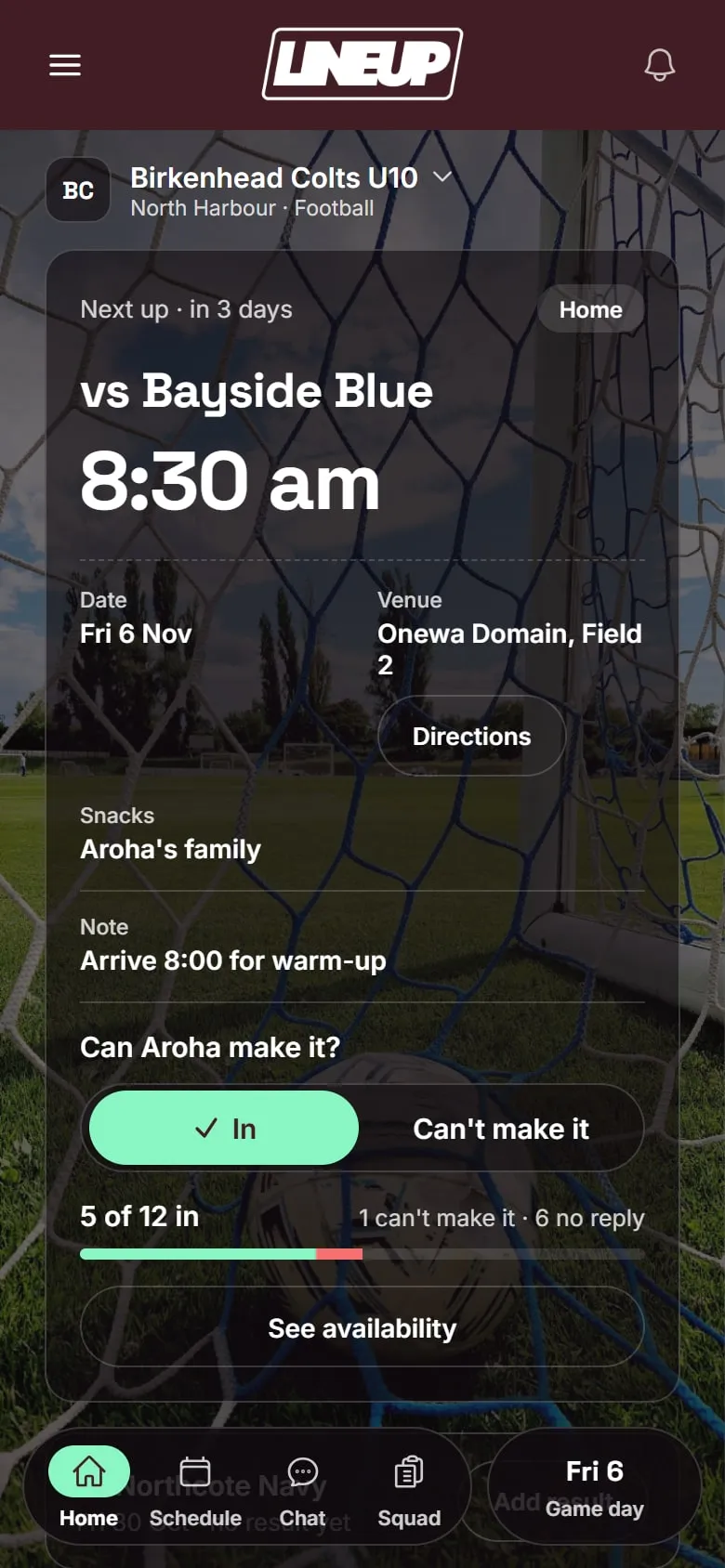
The draw is already in. You added the module’s games once, with the field and the time, and any training repeated itself to the end of the season. Each fixture has a map, and families can add it to their calendar. If the module moves your game to another field, change the fixture and every family sees the new details.
You know who is coming. Parents tap In or Can’t make it on the game. The evening before, LineUp sends a reminder to anyone who has not replied. With six on the field you want two or three on the bench, because touch is a running game, and you know whether you have them before you get to the park.
Families joined with one code. You shared the invite code from LineUp, and each parent joined with it. Children do not have accounts; you add the player names. A parent with children in two teams follows both from one account. How a team gets started takes three steps.
Setting the team up for touch
If the module has not started, this is a ten-minute job.
- Create the team and choose Touch Rugby. Check players on the field, the number of halves and the minutes per half against your module.
- Set the team colour and add the logo. The app re-themes to the team colour.
- Add the roster. Every player’s name, once.
- Add the games from the draw, with the field as the venue.
- Turn on what your team does. Player of the day, snack duty, both or neither.
- Share the invite code wherever the parents already read. If another parent is helping, they can manage the team with you.
Picking the six
On the day, open the fixture and start game day. LineUp lists the players who said In. Choose the six starters and the bench, then give each starter a position, and the field diagram places them. A player who said In but has not turned up yet can be marked arrived later, when they get to the field.
Running each half
The clock. Start it when the referee starts the game. It shows the minutes of the current half and keeps counting past the half’s length, so if it runs long you can see by how much. Tap to pause if play stops.
Time on and time rested. Every player on the field shows time on. Every player on the bench shows time rested, plus the time they have played. Both update every second. Touch is quick, and players come off blowing, so this is the part that is hard to keep in your head.
Half time. Tap End H1 and the break screen shows the score, the substitution panel, the field and the bench. Make any changes there, then start the second half when the referee is ready.
How do rolling subs work in LineUp?
In touch, players change through the substitution box while play goes on, as often as the team likes. LineUp does not make you wait for a break.
Open the substitution panel and LineUp has a suggestion ready:
- Off is the next player in the rotation. The rotation is every starting player in a random order. Each comes off once per cycle, and the order reshuffles when the next cycle starts, so the same child is not first off every week.
- On is the player on the bench who has rested longest.
- Next subs shows the following two or three swaps, so you can tell the next player to get ready in the box.
Tap either name to choose someone else. Tap Make sub and the swap is done: the incoming player takes the outgoing player’s position, the field diagram updates, and the player who came off starts resting.
Swapping positions. If you want a Link out on the Wing, tap a player on the field diagram to swap them. The clock keeps running.
The rotation is a suggestion. LineUp counts the minutes and offers the next turn. You decide.
A worked example: one Saturday’s subs
Say you have nine players at the park. The starters are Aria and Leo on the Wings, Mason and Zara at Link, and Tane and Lucy in the Middle. Kai, Ruby and Finn are on the bench.
4 minutes. Open the panel. LineUp suggests Off Leo, On Kai. Make sub. Kai is now on the Wing, and Leo’s rest clock starts.
6 minutes. Tane scores in the corner. Tap your team’s score card. LineUp asks “Who scored?”, and you pick Tane. The score is 1–0.
8 minutes. The next suggestion is Off Zara, On Ruby. Make sub. Ruby takes the Link.
11 minutes. The other team scores. Tap their score card. A minute later someone taps it again by mistake; Undo takes it back off the board.
12 minutes. Off Lucy, On Finn. Make sub. Finn is in the Middle.
15 minutes. The bench now shows Leo rested 11:00, Zara 7:00 and Lucy 3:00, each with their time played beside it. LineUp suggests Off Mason, On Leo, because Leo has rested longest. Make sub.
20 minutes. Tap End H1. The break screen shows 1–1, the field and the bench, with the next suggested swaps in the panel. You make one change, then start H2 when the referee is ready.
By the end of the game, everyone on the bench has had turns, the minutes are in front of you, and nobody wrote anything down. Nothing about this was enforced by the app. The rotation offered a turn each time, and you could have overridden it whenever you wanted.
Scoring
Each side has a score card at the top of the live screen, and a tap adds a try. A touch try is worth one point, so there is nothing else to choose: no conversions and no Standard or Junior setting. When your side scores, LineUp asks “Who scored?”; pick the player, or skip it if you did not see. Undo takes the last try back off the board and off the player it was credited to.
On the team’s season stats, the scorers list is headed TRIES SCORED.
LineUp keeps the team’s own score. It does not send results to the module or any official competition, so if your module asks the team to confirm the score, do that as well.
Full time
When the referee blows for full time, end the game. If your team picks a player of the day, choose them so the award is saved with the result. The game’s summary shows the result, the try scorers, player of the day and minutes played for every player, and it is saved to the season. If snack duty is turned on, it follows player of the day, so the next family knows it is their turn. On the team screen, the season record adds the result.
A few things touch managers ask
What about mixed grades? LineUp does not record whether a player is a boy or a girl, so it cannot count the mix on the field for you. When you make a sub, check your module’s rule yourself.
What if a player gets hurt? Sub them off like any other change. Their time on stops and the rotation carries on.
What if a player arrives after the start? If they said In, mark them arrived and they join the bench, ready for the next sub.
Does LineUp know the rules of touch? It knows the field, the positions, the halves and that a try is one point. Touches, rollballs and drop-offs stay with the referee.
Can two of us run game day? Yes. Another parent can manage the team with you, so whoever is at the park runs the game.
If you are still choosing an app, Best app for managing a junior touch team in NZ and Australia sets LineUp alongside Sporty, MySideline, Stack Team App and Friendly Manager.
More on touch is here, and if you look after a club with several junior touch teams, get in touch.
Questions people ask
- How many players does LineUp put on the field for touch?
- Six, with two halves of 20 minutes. If your module plays seven a side or shorter halves, change players on the field and the minutes per half in team settings.
- How is a touch try scored in LineUp?
- Each try is worth one point. Tap your team's score card, then pick who scored. Undo takes the last try back off the board and off the player it was credited to.
- Does LineUp count boys and girls on the field for mixed grades?
- No. LineUp does not record a player's gender, so it cannot count the mix on the field. Keep an eye on your module's rule yourself when you make a sub.
- Can I sub while play is going on?
- Yes. Touch subs roll through the substitution box at any time, and the substitution panel works at any time during play, not only at half time.
- Does LineUp send our result to the competition?
- No. LineUp keeps the team's own record. If your module asks the team to confirm the score in Sporty, do that as well.